Best Pull-Up Bars for Home in 2026: Ceiling, Wall, Doorway and Free-Standing
The best pull-up bar depends on your walls, ceiling and door frames. These are our picks for each mounting type, from ceiling joists to no-drill doorway bars.
 By Jordan Hayes
Updated November 5, 2026

A pull-up bar is one of the most useful pieces of equipment for a small home gym, but the right one depends almost entirely on where it will go. A bar that is perfect for a basement with exposed beams is useless in an apartment with drywall and no spare floor.
This guide compares six pull-up bars, one for each common way to mount them: ceiling joists, a masonry wall, exposed beams, free-standing, an elevated doorway bar and a no-screw door frame bar. Each was judged on the same criteria and scored with the CGG Score.
Safety note: this guide is general product information, not medical or fitness advice. Talk with a doctor before starting a new exercise routine, and follow each manufacturer’s weight limit and setup instructions. See our health and safety policy.
| Award | Product | CGG Score About CGG ScoreThe CGG Score is a 0 to 10 rating calculated from each product's average Amazon customer rating, scaled so a 3.0 rating equals 6.2 and a 5.0 rating equals 9.4. Affiliate commissions never affect it. Learn more › | |
|---|---|---|---|
| Best Overall |
 Ultimate Body Press Ceiling Mount Pull-Up Bar |
8.8/10 | Buy |
| Best Premium |
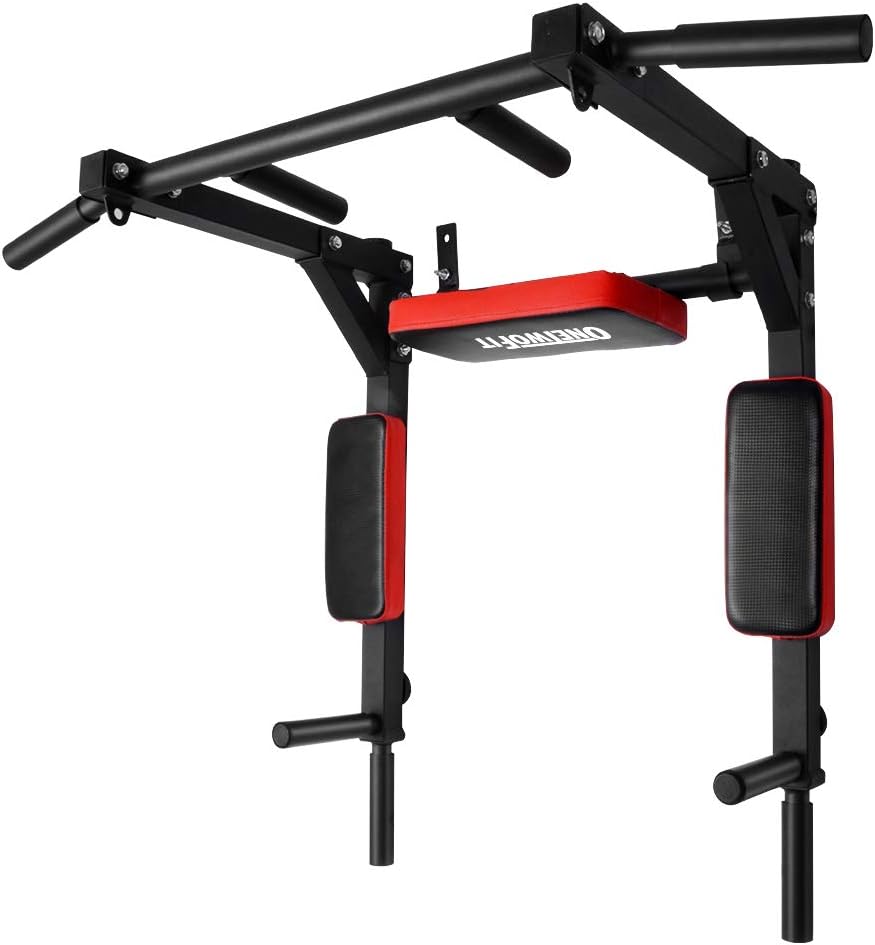 OneTwoFit Wall-Mounted Pull-Up Bar and Dip Station |
8.8/10 | Buy |
| Best Budget |
 Fitarc Joist Mount Pull-Up Bar |
8.6/10 | Buy |
| Best Value |
 YYJO Foldable Free-Standing Pull-Up Station |
8.6/10 | Buy |
 Ultimate Body Press XL Doorway Pull-Up Bar |
8.4/10 | Buy | |
 Sunny Health & Fitness Adjustable Doorway Pull-Up |
8.0/10 | Buy |
Ultimate Body Press Ceiling Mount Pull-Up Bar
A 48-inch straight bar on 14-inch risers that bolts into ceiling joists spaced 16 or 24 inches apart. The brand designs it for 8-foot ceilings and lists a 450 lb capacity and a 10-year limited warranty.
Pros
- Bolts to 16 or 24 inch joists
- Long 48-inch straight bar
- 450 lb listed capacity
- 10-year limited warranty per listing
- Anchor point for rings or straps
Cons
- Permanent install into joists
- Sized for about 8-foot ceilings
OneTwoFit Wall-Mounted Pull-Up Bar and Dip Station
A combined pull-up and dip station with padded back and arm cushions, mounted with four 7 mm anchors into concrete or brick. OneTwoFit warns against drywall, plaster or cavity walls. Listed capacity is 440 lb.
Pros
- Pull-ups, dips and knee raises in one
- Padded back and arm rests
- 440 lb listed capacity
- Tied for the highest rating here
Cons
- Concrete or brick walls only
- Large unit, about 37.4 x 30.3 in
Fitarc Joist Mount Pull-Up Bar
A simple joist or beam-mounted bar with four foam grip positions and a 440 lb listed capacity. It suits basements and garages with exposed wooden beams.
Pros
- Mounts to wooden joists or beams
- Four foam-covered grips
- 440 lb listed capacity
- Compact, about 42.5 inches wide
Cons
- Needs exposed or accessible beams
- No warranty stated on listing
YYJO Foldable Free-Standing Pull-Up Station
A free-standing pull-up and dip station with a triangular base that folds to about 33.5 x 6.3 inches of floor space. It has 11 bar heights from about 69 to 83 inches and comes with assistance bands.
Pros
- No drilling or door frame needed
- Folds flat, about 6 inches deep
- 11 bar heights, about 69 to 83 in
- Assistance bands included
Cons
- 350 lb listed capacity
- Large footprint when open
Ultimate Body Press XL Doorway Pull-Up Bar
A doorway bar that sits about 1 inch above the trim and 10 inches from the wall, giving more head clearance than many doorway bars. It fits frames 24 to 36 inches wide and doubles as a floor station for push-ups and dips.
Pros
- Elevated bar for more clearance
- Fits doorways 24 to 36 in wide
- No drilling
- 10-year limited warranty per listing
Cons
- 300 lb listed capacity
- Needs sturdy trim up to 3.5 in wide
Sunny Health & Fitness Adjustable Doorway Pull-Up
A telescoping bar that installs inside a door frame without screws, with an anti-rotation lock and foam grips for neutral, wide and reverse holds. Side markers help you extend it evenly.
Pros
- No screws or drilling
- Anti-rotation lock
- Multiple grip positions
- 330 lb listed capacity
Cons
- Lowest rating in this group
- Depends on a rigid door frame
Pull-Up Bars Compared by Mounting Type
| Model | Mounting | Drilling | Listed Capacity | Main Limit |
|---|---|---|---|---|
| Ultimate Body Press CMP-48 | Ceiling joists | Yes | 450 lb | Ceiling height and joist spacing |
| OneTwoFit | Concrete or brick wall | Yes, hammer drill | 440 lb | Not for drywall |
| Fitarc | Wooden joists or beams | Yes | 440 lb | Needs accessible beams |
| YYJO | Free-standing | No | 350 lb | Floor space |
| Ultimate Body Press XL | Over door trim | No | 300 lb | Trim strength and width |
| Sunny Health & Fitness | Inside door frame | No | 330 lb | Rigid door frame |
Figures come from each Amazon listing at the time of our review; confirm them before you buy.
How We Picked These Pull-Up Bars
We grouped pull-up bars by mounting type and chose a well-rated model for each, with no product repeated from our other pull-up guides. We then compared them on:
- Mounting requirements: what your walls, ceiling or door frame must be made of.
- Listed capacity and any conflicting load figures on the listing.
- Grip options and clearance for full pull-ups.
- Footprint and storage for free-standing and removable bars.
- Warranty as stated by each brand.
Our full method is on the How We Review page.
Pull-Up Bar Buying Guide
Start With Your Home
- Renting with drywall: a doorway or free-standing bar avoids drilling.
- Basement or garage with exposed beams: a joist or ceiling mount is the most solid option.
- Concrete or brick wall: a wall-mounted station adds dips and knee raises.
- No suitable door frame or walls: a free-standing station or power tower needs only floor space.
Mounted Bars Need the Right Structure
Ceiling and wall mounts are only as strong as what they are bolted into. Joist mounts must go into solid wood joists, and masonry mounts like the OneTwoFit need concrete or brick. Never mount a pull-up bar into drywall alone. If you are unsure about your framing, ask a qualified contractor before drilling.
Doorway Bars Depend on the Frame
Doorway bars rest on trim or press against the frame, so a weak or narrow frame is the main risk. Measure the door width and trim depth against the listing, try a slow, controlled hang before full pull-ups, and avoid doorways in tile, glass or hollow partition walls. Our best doorway pull-up bars guide covers more options.
Clearance and Ceiling Height
You need room above the bar to bring your chin over it, and room below to hang with your arms straight. Ceiling bars hang down on risers, so check the brand’s recommended ceiling height. Elevated doorway bars like the Ultimate Body Press XL sit farther from the wall to give your head more space.
Capacity
Listed capacities here range from 300 to 450 lb. Choose a bar rated comfortably above your body weight plus any vest or added load. Where a listing gives two figures, plan around the lower one.
Who Should Skip a Pull-Up Bar
- Anyone who cannot yet hang safely, who may want to start with resistance bands and assisted variations.
- Renters whose lease forbids drilling and whose door frames are not rigid.
- People planning kipping or weighted dynamic moves, which need a properly anchored rig.
Why You Should Trust Us
CompactGymGuide compares pull-up bars for small homes using published specifications, manufacturer documentation, and patterns in verified owner feedback. Every product in this guide was judged against the same criteria, and each one carries a CGG Score, a 0 to 10 rating calculated from its average Amazon customer rating with a formula we publish on our How We Review page.
We do not conduct our own product trials; our evaluations are grounded in research, published data, and verified buyer feedback. We may earn a commission when you buy through our links, but that never changes which products we include or how they rank. Details are in our affiliate disclosure.
Final Thoughts
Pick the mounting type your home supports first, then the bar. A properly installed ceiling or joist mount is the most solid; doorway and free-standing bars are the most flexible.
- Best Overall: Ultimate Body Press Ceiling Mount Pull-Up Bar, tied for the highest rating here, with a long straight bar and a 10-year limited warranty per the listing.
- Best Premium: OneTwoFit Wall Mounted Pull-Up Bar and Dip Station, which adds dips and knee raises on a masonry wall.
- Best Value: YYJO Foldable Free-Standing Pull-Up Station, which needs no drilling and folds flat.
- Best Budget: Fitarc Joist Mount Pull-Up Bar, a simple bar for exposed beams.
- Best Doorway Bar: Ultimate Body Press XL, with an elevated bar for more head clearance.
Browse more in our pull-up bars section, or see other bodyweight training gear.
Frequently Asked Questions
What type of pull-up bar is best for an apartment?
Usually a doorway bar or a free-standing station, since neither needs drilling. Check your lease and make sure the door frame is rigid before using a doorway bar.
Can I mount a pull-up bar on drywall?
Not on drywall alone. Ceiling and wall mounts must be bolted into solid wood joists or masonry as the manufacturer specifies.
Do doorway pull-up bars damage door frames?
They can mark or stress weak trim. Pads help, but the frame must be solid. Follow the fit range on the listing and check the trim regularly.
How much ceiling height do I need?
Enough to clear your head above the bar during a pull-up. Ceiling mounts with risers are often designed around 8-foot ceilings; check the brand’s guidance.
About the author
Jordan Hayes is an editor at CompactGymGuide covering home gym equipment for small spaces, from folding cardio machines to adjustable weights. He researches product specifications, manufacturer documentation, and verified owner feedback to build practical buying guides for people who train at home.