Best Home Gym Flooring in 2026: Rubber Rolls, Stall Mats and Tiles
The right gym floor protects your home and makes training safer. These are the rubber rolls, stall mats, tiles and large mats we recommend by type of training.
 By Jordan Hayes
Updated November 5, 2026
The right floor makes a home gym safer, quieter and easier on the room it sits in. It protects wood, tile and concrete from weights and machines, gives your feet better grip, and softens the sound of training.
We compared eight home gym flooring options across the four main types: rubber rolls, rubber stall mats, rubber-top foam tiles and large one-piece mats. Each was judged on the same criteria and scored with the CGG Score.
Safety note: this guide is general product information, not medical or fitness advice. Talk with a doctor before starting a new exercise routine, and follow each manufacturer’s weight limit and setup instructions. See our health and safety policy.
| Award | Product | CGG Score About CGG ScoreThe CGG Score is a 0 to 10 rating calculated from each product's average Amazon customer rating, scaled so a 3.0 rating equals 6.2 and a 5.0 rating equals 9.4. Affiliate commissions never affect it. Learn more › | |
|---|---|---|---|
| Best Overall |
 American Floor Mats 3/8-Inch Rubber Roll |
8.9/10 | Buy |
| Best Premium |
 GXMMAT Extra Large Exercise Mat (7 mm) |
8.9/10 | Buy |
| Best Budget |
 MSI Utility Rubber Stall Mat (3/4 Inch) |
8.8/10 | Buy |
 SUPERJARE Rubber Top Gym Flooring Tiles |
8.6/10 | Buy | |
 American Floor Mats Stall Mat (3/8 Inch, 3 x 4 ft) |
8.6/10 | Buy | |
 Rubber-Cal Elephant Bark Rubber Flooring Roll |
8.6/10 | Buy | |
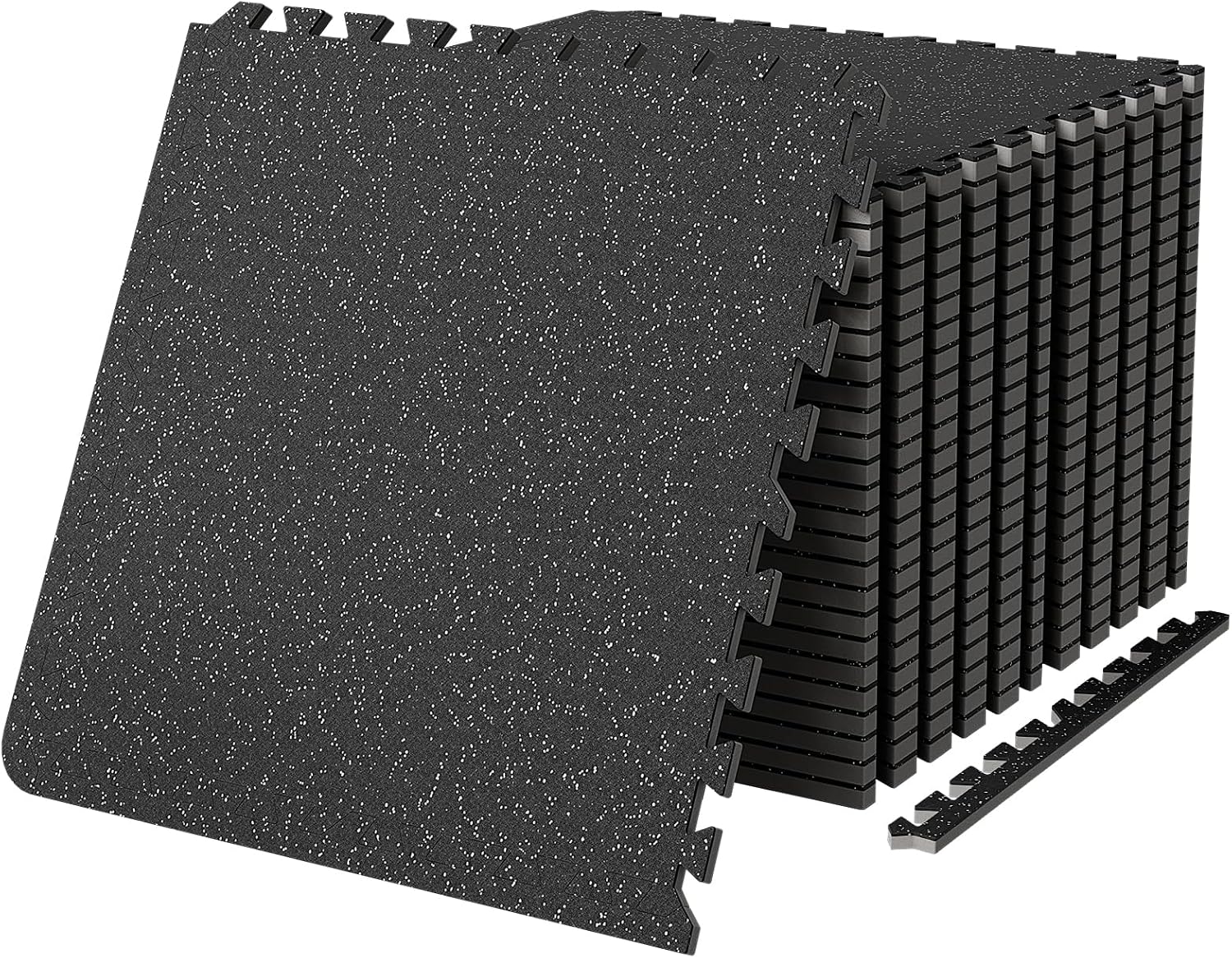 VEVOR Rubber Top Gym Tiles (100 Sq Ft) |
8.4/10 | Buy | |
| Best Value |
 IncStores 1/4-Inch Tough Rubber Roll |
8.3/10 | Buy |
American Floor Mats 3/8-Inch Rubber Roll
A solid rubber roll about 3/8 inch thick that covers 32 square feet in one piece. It is built for floor protection under weights and machines, and the roll format leaves fewer seams than tiles.
Pros
- One 4 x 8 ft piece, few seams
- Solid rubber, about 3/8 inch
- Suits weights and machines
- Wipes clean
Cons
- Heavy and awkward to carry in
- Listing gives two thickness figures
- May smell of rubber at first
GXMMAT Extra Large Exercise Mat (7 mm)
A one-piece 7 mm mat listed from 8 x 6 ft up to 16 x 6 ft, with non-slip texture on both sides. It is made for cardio, jump rope and bodyweight work with or without shoes, and rolls up with straps.
Pros
- Large one-piece sizes up to 16 x 6 ft
- Shoe-friendly, double-sided grip
- Rolls up with straps and bag
- About 24 lb for the 8 x 6 ft size
Cons
- Not designed for dropped weights
- Thinner than rubber flooring
MSI Utility Rubber Stall Mat (3/4 Inch)
A heavy 3/4-inch rubber stall mat, the thickest option here, of the kind many home lifters use under racks and benches. It weighs about 69 lb and wipes or brushes clean.
Pros
- 3/4 inch dense rubber
- Dense rubber for heavy equipment
- Wipes or brushes clean
- Suits racks and benches
Cons
- About 69 lb, hard to move
- Listing gives two different sizes
- Rubber odor likely at first
SUPERJARE Rubber Top Gym Flooring Tiles
Twelve 24 x 24 inch tiles with an EPDM rubber top over high-density EVA foam, covering 48 square feet. Interlocking edges and detachable borders let you fit them to a room and take them up later.
Pros
- Rubber top over EVA foam
- 48 sq ft from twelve 2 x 2 ft tiles
- Borders included for clean edges
- Light and easy to lay or move
Cons
- Foam base compresses under heavy loads
- Seams can shift with lateral moves
American Floor Mats Stall Mat (3/8 Inch, 3 x 4 ft)
A 3 x 4 ft, 3/8-inch rubber stall mat made in the US per the listing. It is a small, affordable way to protect the floor under a bench, a pair of dumbbells or a single machine.
Pros
- Made in the US per listing
- Dense 3/8-inch rubber
- Small size fits a single station
- Easy to clean
Cons
- Covers only 12 sq ft
- Several needed for a full area
Rubber-Cal Elephant Bark Rubber Flooring Roll
A recycled rubber roll about 3/16 inch thick that covers a long strip in one piece, sold in six colors. It installs without adhesive and resists water and UV, so it also works on patios and in basements.
Pros
- Large one-piece roll, about 4 x 20 ft
- No adhesive needed
- Six color options
- Water and UV resistant
Cons
- Thin for heavy weights
- About 77 lb to maneuver
VEVOR Rubber Top Gym Tiles (100 Sq Ft)
Twenty-five 25 x 25 inch tiles with a rubber top over EVA foam, 0.56 inch thick, covering about 100 square feet. Two end borders come with each tile for a finished edge.
Pros
- Covers about 100 sq ft
- Rubber top over EVA foam
- Interlocking, no glue
- Wipes clean with a damp cloth
Cons
- No warranty stated on listing
- Foam base not built for dropped weights
IncStores 1/4-Inch Tough Rubber Roll
A 1/4-inch recycled rubber roll made in the USA, sized 4 x 10 ft in this listing. IncStores states a 5-year warranty and markets it for areas under benches, machines and treadmills.
Pros
- Made in the USA
- Recycled rubber roll, 4 x 10 ft
- 5-year warranty per listing
- Moisture resistant
Cons
- 1/4 inch is thin for heavy drops
- Rubber smell when new
Home Gym Flooring Compared
| Product | Type | Thickness | Coverage | Best For |
|---|---|---|---|---|
| American Floor Mats roll | Rubber roll | About 3/8 in | 4 x 8 ft | Weights and machines |
| GXMMAT | PVC one-piece mat | 7 mm | 8 x 6 ft and larger | Cardio and bodyweight |
| MSI stall mat | Rubber stall mat | 3/4 in | About 3.5 x 6 ft | Racks and heavy lifting |
| SUPERJARE tiles | Rubber-top EVA tiles | 0.56 in | 48 sq ft | Mixed training |
| American Floor Mats stall mat | Rubber stall mat | 3/8 in | 3 x 4 ft | A single station |
| Rubber-Cal Elephant Bark | Rubber roll | 3/16 in | About 4 x 20 ft | Large light-use areas |
| VEVOR tiles | Rubber-top EVA tiles | 0.56 in | About 100 sq ft | Large mixed areas |
| IncStores roll | Rubber roll | 1/4 in | 4 x 10 ft | Under machines and benches |
Figures come from each Amazon listing at the time of our review. Several products come in more sizes; confirm the version before you buy.
How We Picked This Flooring
We started from home gym flooring on Amazon with a meaningful base of verified owner ratings and included each common type, so you can compare options for different kinds of training. We then compared them on:
- Material: solid rubber, rubber over foam, or PVC.
- Thickness and how it matches the loads you train with.
- Coverage and format: rolls, single mats or interlocking tiles.
- Installation and weight: how hard it is to carry, cut and lay.
- Care and warranty as stated on the listing.
Our full method is on the How We Review page.
Home Gym Flooring Buying Guide
Match the Floor to Your Training
- Cardio, bodyweight and stretching: a large PVC mat or foam tiles give cushioning and grip.
- Dumbbells, benches and machines: rubber rolls, rubber-top tiles or stall mats protect the floor from dents and scratches.
- Heavy barbells and racks: thick rubber, such as 3/4-inch stall mats, is the usual choice. Foam-based tiles are not designed for dropped weights.
Rubber Rolls, Stall Mats or Tiles
Rolls cover large areas with few seams and look tidy, but they are heavy and need careful cutting around doorways. Stall mats are dense, thick and affordable for their weight class, but each piece is heavy and they come in fixed sizes. Interlocking tiles are light, easy to lay and easy to take up when you move, but the seams can shift and foam bases compress under heavy loads.
Thickness
Thickness in this guide ranges from 3/16 inch to 3/4 inch. Thin rubber protects floors from scratches and rolling equipment. Thicker rubber spreads the load from heavy weights better and reduces impact sound. Thick floors also raise the surface height, so check door clearances.
Rubber Smell
Recycled rubber usually has a noticeable smell when new. Brands commonly suggest airing it out before installing it indoors. If you are sensitive to odors, unroll it in a garage or ventilated room for several days, or consider rubber-top tiles, which some brands say have less odor.
Floors Underneath
Concrete in a garage or basement can take any of these options. Over hardwood, laminate or vinyl, choose a material the brand says is safe for that surface and clean under it occasionally. Carpet is the hardest base: tiles can shift and thin mats can wrinkle, so a firm, heavy option works best.
Under Machines
For a single treadmill, bike or rower, a dedicated equipment mat is often enough. For floor exercises, see our best exercise mats guide.
Who Should Skip These Options
- Olympic lifters dropping loaded barbells, who need a purpose-built lifting platform rather than flooring alone.
- Renters who cannot move heavy rubber, who may prefer light interlocking tiles they can take up easily.
- People training only on a mat-sized area, who can save money with a single exercise or equipment mat.
Why You Should Trust Us
CompactGymGuide compares home gym flooring for small homes using published specifications, manufacturer documentation, and patterns in verified owner feedback. Every product in this guide was judged against the same criteria, and each one carries a CGG Score, a 0 to 10 rating calculated from its average Amazon customer rating with a formula we publish on our How We Review page.
We do not conduct our own product trials; our evaluations are grounded in research, published data, and verified buyer feedback. We may earn a commission when you buy through our links, but that never changes which products we include or how they rank. Details are in our affiliate disclosure.
Final Thoughts
Choose flooring by what you lift and how permanent your gym is. Rubber rolls and stall mats suit long-term setups with weights; interlocking tiles and large mats suit lighter training and spaces that change.
- Best Overall: American Floor Mats 3/8-Inch Rubber Roll, tied for the highest rating here, with a seamless 4 x 8 ft piece of solid rubber.
- Best Value: IncStores 1/4-Inch Tough Rubber Roll, made in the USA with a 5-year warranty per the listing.
- Best Budget: MSI 3/4-Inch Rubber Stall Mat, the thickest option here, for racks and heavy lifting.
- Best Premium: GXMMAT Extra Large Exercise Mat, a one-piece mat up to 16 x 6 ft for cardio and bodyweight work.
- Best Interlocking Tiles: SUPERJARE Rubber Top Tiles, with a rubber surface over foam and finished borders.
Browse more in our gym flooring section, or read how to set up a small home gym.
Frequently Asked Questions
What is the best flooring for a home gym?
It depends on how you train. Rubber rolls and stall mats suit weights and machines, rubber-top foam tiles suit mixed training, and large PVC mats suit cardio and bodyweight work.
How thick should home gym flooring be?
Thin rubber around 1/4 inch protects floors under machines and light weights. For heavier dumbbells and racks, thicker rubber up to 3/4 inch spreads the load better. Foam tiles are not designed for dropped weights at any thickness.
Are horse stall mats good for a home gym?
Many home lifters use them under racks and benches because they are thick and dense. They are heavy, come in fixed sizes and usually smell of rubber when new.
Can I put gym flooring over carpet?
Yes, but carpet is a soft base. Heavy, firm options stay flatter, while light tiles can shift. Check that machines and benches sit level.
How do I reduce the rubber smell?
Air new rubber flooring out in a ventilated space before installing it, and clean it with a mild cleaner the brand recommends.
About the author
Jordan Hayes is an editor at CompactGymGuide covering home gym equipment for small spaces, from folding cardio machines to adjustable weights. He researches product specifications, manufacturer documentation, and verified owner feedback to build practical buying guides for people who train at home.